
The breath before the gesture.

This month, we continue our series on creative process and interdisciplinary work with an article from Asia Mieleszko reflecting on photographing Vice Versa's New York show last May. Catch Asia as a performer and creator at our upcoming production on Philadelphia next month!
Please shed light on where your art is rooted and how improvisation relates to your artistic process. How does your creative process shift when collaborating with others?
It’s 10:04 A.M. I’m chest-down on the ground, legs lightly contorted, holding my breath, one eye shut, the other squinting. Through the lens, Sarah and Valerie trace their choreography. It probably looks like I’m poorly miming them. I may have been. I was trying to capture not just what they were doing, but how it felt, how it sounded.


On May 24th, 2025, in Valerie Green’s personal studio, Vice Versa, a brand new collective was preparing their first ever showcase. I was there to document the process.
I knew as much walking in as any of the performers because what makes Vice Versa unique is that most of the work is done on site, within hours of the public presentation. There’s plenty of administrative and organizational prep in the months leading up to a show, but the thing you come to see — the intersection of dance, music, and visual art — 97% of that is negotiated 24-48 hours ahead of time. That’s the point. Or at least how it seemed to me.
As the documentarian, I wasn’t given any particular instruction, just afforded a lot of trust. I decided, I’ll perform too.
I found myself miming the sensations I saw and felt: disagreement, uncertainty, stillness, excitement, exhaustion, curiosity, openness. When everything is unfolding at once, I instinctively close in. I thought about how, at the symphony, I always end up tracking a single performer — the principal cellist, the conductor. A full orchestra in front of me, and I can only commit to one musician. Find the anchor point in the chaos and ride whatever current it offers.
That kind of focus is where improvisation begins for me. Photography has always required it. I don’t know what will happen next, only that I have to stay awake to every possibility. Sports and events photographers know this well: you’re always predicting the next move so you can meet it with your shutter. In improvised performance, that same anticipatory listening takes over. You’re tuned to the breath before the gesture.
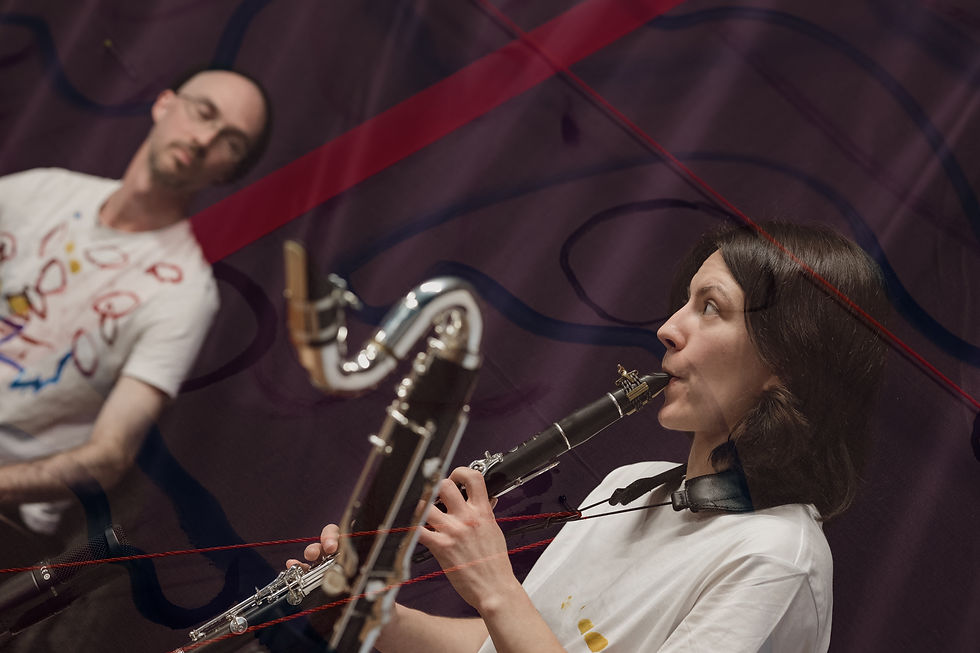

Anyone who knows my work knows I work strictly in-camera. Whatever strangeness or magic ends up in the final frame was born in that moment, not summoned later on a screen. Which means that while I’m poised to press the shutter, I’m also navigating a second layer of improvisation: Double exposure? Blur? Drag? Flash? Or hold still and let the moment stand as it is?
In contrast to portrait photography, when you’re documenting performance or process, you’re not giving direction. Neither are you receiving it. Sometimes someone will step into my frame at the perfect time; other times, they’ll “ruin” my shot. Sometimes the best shot comes from an accident. A moment slips; another arrives.
Again, it’s improv. Every moment contains a hundred possible futures. Each choice opens one universe and closes another. None of them are wrong; they’re just different paths. And because there’s no verbal direction, the only thing you can rely on is trust: trust in your timing, trust in the people you’re moving with, trust that the moment will hold if you meet it honestly.
Vice Versa’s spontaneity shaped my decisions, and my decisions shaped the record they have of their own process. In the end, it felt less like documenting a show and more like participating in the same unfolding — moving through uncertainty with everyone else and trusting that something meaningful would emerge if we all stayed present enough.



Comments